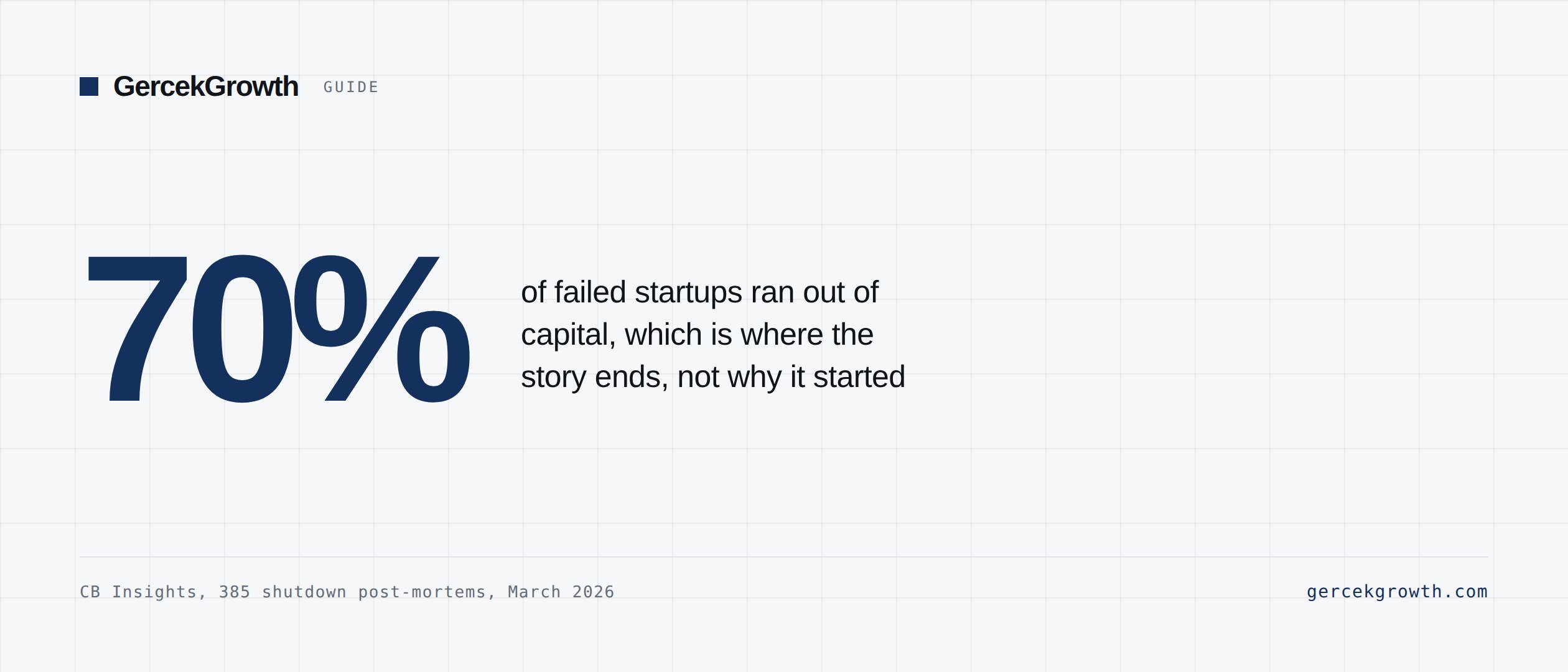
Short answer: In CB Insights' March 2026 analysis of 385 shutdown post-mortems from 431 VC-backed companies that closed since 2023, the reasons run: 70% ran out of capital, 43% poor product-market fit, 29% bad timing or macro conditions, 19% unsustainable unit economics. Companies cited more than one reason, so the total exceeds 100%. What matters is this: running out of capital is where the story ends, not where it started. The five subjects below are the places that signal months before the cash does. For a SaaS company selling from Türkiye into the US or EU, four of them are broken by default.
Why the list has to be read backwards
"Ran out of money" is a death certificate, not a diagnosis. The CB Insights report says as much itself: the telling causes are poor product-market fit (43%), timing (29%) and unsustainable unit economics (19%), and the capital drying up is their consequence.
The practical consequence: by the time cash runs out there is no action left to take. So the thing to track is not the bank balance but the mechanisms that drain it. Those mechanisms are below, ordered by how early each one gives a signal.
1. Measuring PMF by cohort, not by feel
Product-market fit is where founders most often fool themselves. The problem is rarely a lack of measurement; it is the wrong measurement. Total users, total revenue and blended churn all accumulate in a way that can look like improvement.
Read by cohort, the same data speaks differently. If fewer of January's customers survive to month six than April's did, the product is getting worse even while total revenue rises. I set out the order in which the metrics should be read, with benchmark numbers, in a separate article.
2. Unit economics: if payback is longer than runway, growth kills you
Benchmarkit's 2025 data puts the median new-customer CAC ratio at $2.00, and CAC payback has lengthened by 12.5% at the median since 2022. Those two figures combine into the arithmetic founders most often miss.
If your payback is 18 months and your runway is 12, every new customer you win makes the cash position worse before it makes it better. In that state, accelerating growth accelerates the ending. Founders usually do the opposite: when sales are slow they spend more on sales and marketing. The right order of questions is payback period first, runway second, and whether to accelerate last.
3. Payments: collecting globally from Türkiye does not work by default
This is the wall nobody puts on the roadmap and everybody meets once the product is ready. Stripe does not support accepting payments from businesses registered in Türkiye. In practice, global SaaS collection from Türkiye runs through merchant-of-record (MoR) platforms, and that carries a cost.
- Paddle: 5% + $0.50 per transaction, plus a flat $15 SWIFT fee per payout. On a $300 monthly subscription that comes to roughly 10.2% in total deductions. No TRY payouts.
- Polar.sh: 5% + $0.50, with a further 1.5% on international cards. Because payouts run through Stripe Connect there is no flat SWIFT fee, and it can pay out in TRY. On the same $300 scenario, roughly 8% in total.
- Lemon Squeezy: 5% + $0.50, though the product is being folded into Stripe Managed Payments.
- Local virtual POS: iyzico at roughly 4.29% + 0.25 TL, PayTR at roughly 2.19%. These are for domestic collection; they do not solve global card acceptance or tax compliance.
The real issue is not the rate, it is when the rate reaches your pricing. The industry benchmark for subscription gross margin is 81%. If 8% to 10% of your revenue goes to the payment layer and you did not price for it on day one, that benchmark is not true of your company. Putting the MoR cost into the pricing model at the start is easier than raising prices in year two.
MoR platforms take on tax calculation, collection and chargeback handling, which also transfers a large part of the obligation in the next section. Exactly what each platform assumes varies by contract and needs confirming with your accountant.
4. Tax: there is no threshold for you in the EU
This is the most common piece of wrong information. The €10,000 threshold for digital services in the EU applies only to sellers established in the EU. For a company established outside the EU there is no threshold: on B2C sales you must charge the customer's country VAT rate from the first euro.
- On B2C sales: destination-country VAT applies. To evidence where the customer is, you need at least two non-contradictory pieces of evidence: billing address, IP address, country of bank, country of SIM card, and so on.
- On B2B sales: reverse charge applies and you collect no VAT. But you must validate the customer's VAT number through VIES at the time of sale. Simply storing the number they claimed is not enough to defend a B2B classification in an audit. The invoice also needs a line to the effect of "Reverse charge: VAT to be accounted for by recipient".
- Registration: non-EU sellers register through the Non-Union OSS scheme in a single member state and file quarterly returns covering all 27.
This is not tax advice. What you owe depends on whether you use a MoR, on your corporate structure and on your sales model; confirm it with your accountant and, where needed, an adviser on the EU side before acting.
5. The technical health of your distribution channel is now a gate, not a best practice
Cold email and product email remain the cheapest distribution channel in B2B SaaS, but since 2024 there is an identity check at the door. Google, Yahoo and Microsoft all treat anyone sending 5,000 or more emails a day as a bulk sender, and require:
- SPF and DKIM records that exist and pass, with at least one of them aligned to the domain in the From header.
- A DMARC policy of at least `p=none`, with a reporting address (rua).
- FCrDNS (forward-confirmed reverse DNS) and TLS in transit.
- Spam complaint rates kept below 0.10%, and never reaching 0.3% (Google and Yahoo).
- RFC 8058 one-click unsubscribe on marketing mail, with requests processed within two days.
Enforcement has hardened too: Google and Yahoo began in February 2024 with 421 errors, Microsoft Outlook.com followed on 5 May 2025, and in November 2025 Google escalated to permanent 550 rejections. Non-compliant mail is no longer delayed, it is refused.
A SaaS company starting cold outbound into the US from a newly registered domain in Türkiye violates all of the above by default. To see where your own domain stands, the SPF, DKIM and DMARC check queries it live.
Sequence: what to look at, and when
- Before the product is ready: choose the payment infrastructure and MoR cost, and put it in the pricing model. Adding it later means a price rise.
- Before the first foreign customer: settle the VAT obligation and the VIES validation flow. The first sale already creates the obligation.
- Before the first campaign: SPF, DKIM, DMARC and one-click unsubscribe. Repairing a burned domain takes months.
- After the first ten customers: start measuring cohort retention. Blended churn will mislead you.
- Before deciding to scale: compare CAC payback against runway. If those two are the wrong way round, do not accelerate.
If you would rather have the whole system taken apart than hunt through these five one at a time, that is what the Outbound Audit does.
Sources
- Why Startups Fail: Top ReasonsCB Insights, 2023'ten beri kapanan 431 VC destekli şirketin 385'i, Mart 2026
- 2026 bulk email sender requirements: Microsoft, Google, and Yahoo compliance guideRed Sift, 2026
- SaaS Payments from Türkiye: Stripe Alternatives and Real Costsceaksan.com
- EU VAT for SaaS in 2026: Thresholds, OSS, and Common MistakesDodo Payments, 2026
- 2025 B2B SaaS Performance Metrics BenchmarksBenchmarkit, 2024 verisi
Every figure above is linked to its primary source and dated. Where a number is asserted by a source rather than measured, the text says so. If you find something out of date, tell me and I will correct it.