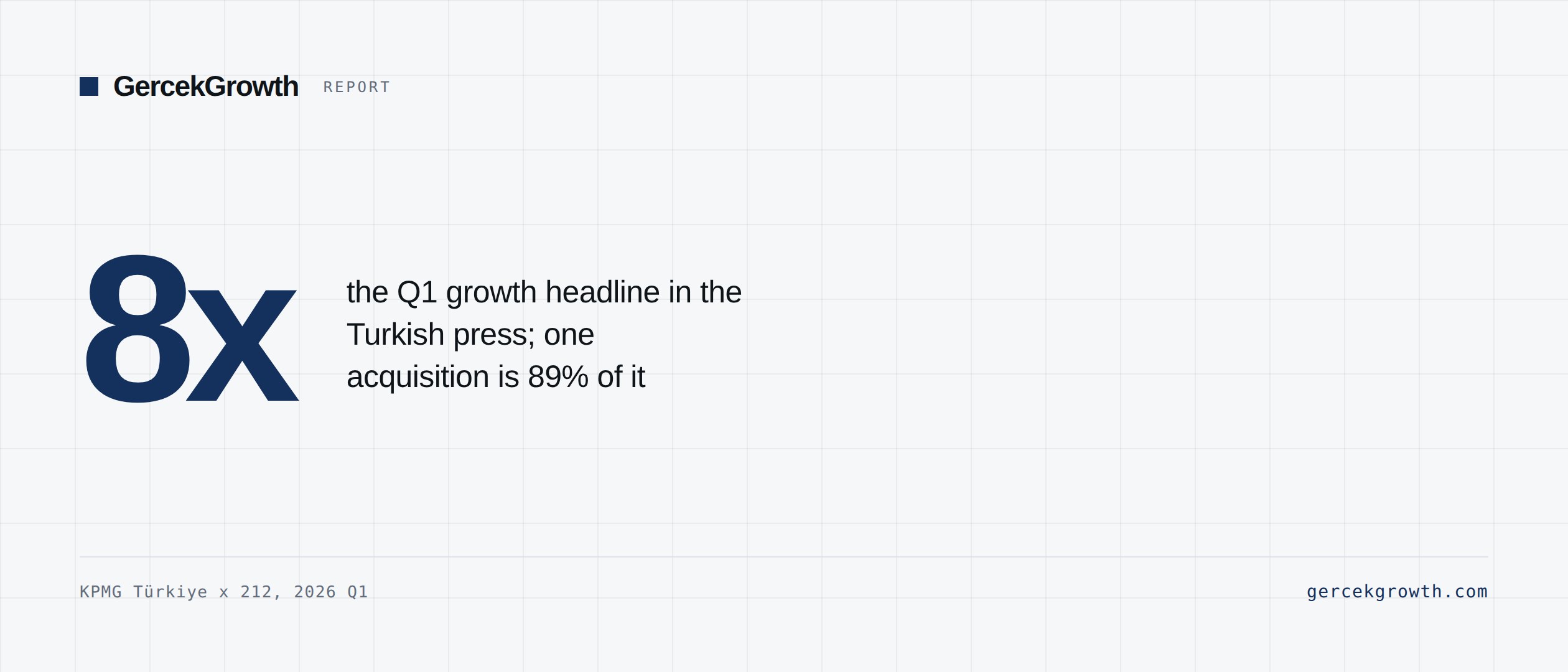
Short answer: The Turkish startup story of the last 30 days was not new rounds, it was numbers. Three trackers measured the same half year and published three different totals: startups.watch $172 million across 87 rounds; StartupCentrum $178 million across 101 rounds; and KPMG Türkiye with 212 $559.2 million for the first quarter alone. The gap is not error, it is definition: KPMG counts acquisitions. The eightfold growth headline that circulated in the Turkish press rests largely on one transaction, Scopely taking 50% of Loom Games for about $500 million. KPMG's own report states that excluding acquisitions, the same quarter was roughly $50 million.
What actually happened in the last 30 days
The rounds announced between 28 July and 27 August 2026 are small. The largest is Surge Games, a studio building puzzle games on an AI-assisted production pipeline, which raised $3 million on 24 August from Simya VC, Play Ventures and Drilo. It is Simya VC's 17th portfolio investment and its first outside B2B.
Two more sit alongside it: Kahuna, at the intersection of music and fintech, closed a seed round with Yapay Zeka Fabrikası participating (13 August), and Ingosa, an AI-driven adtech startup, raised from FutureBright (7 August). Beyond those there are launches rather than rounds: oiplan's business management platform and Fintables' financial assistant Evo.
So the largest disclosed round inside the window is $3 million. Every large number being discussed this month comes from half-year reports published just before it, between 14 June and 10 July. "Most discussed in the last 30 days" and "raised the most in the last 30 days" are two different questions, and this month they have different answers.
Three trackers, three totals
There is no single figure for H1 2026. There are three, and none of them is wrong. They count different things.
- startups.watch: $172 million, 87 rounds. Investment rounds.
- StartupCentrum: $178 million, 101 rounds. Includes 28 TÜBİTAK BİGG public grant rounds and 12 crowdfunding rounds.
- KPMG Türkiye with 212: $559.2 million across 42 transactions, first quarter only. Acquisitions included.
The $6 million gap between startups.watch and StartupCentrum comes down to whether public grants and crowdfunding are counted. The KPMG gap is on a different axis entirely: that figure is transaction volume rather than investment, and company acquisitions are inside it.
The moment you quote one of these without saying which, the number becomes a headline. For the same ecosystem, 172 is correct and 559.2 is correct. They just cannot sit in the same sentence.
What sits under the eightfold headline
The line that circulated in mid June was that the Turkish startup ecosystem grew eightfold in the first quarter. The arithmetic is real: $559.2 million in Q1 2026 against $70.2 million in Q1 2025.
The same report also says this: excluding acquisitions, all investment from seed through late stage was about $50 million. The difference is one transaction, Scopely taking 50% of Loom Games for roughly $500 million in February 2026. A single deal is about 89% of the quarterly figure.
Measuring the same quarter as investment rounds, startups.watch finds $64 million across 39 rounds. So the answer to "how much new capital entered the ecosystem in Q1" is somewhere between $50 and $64 million depending on who you ask. It is not 559.2.
This is not a way of dismissing the acquisition. The Loom Games exit is one of the largest outcomes the ecosystem has produced and it is real money for founders and investors. The point is which question a number answers: "how much value was created" and "how much capital went into new companies" are not the same question, and one total cannot answer both.
Gaming takes the money, AI takes the deal count
On startups.watch numbers, gaming took $111.4 million in H1, 65% of the total. Two rounds carry it: Grand Games at $70 million in Q2 and TaleMonster Games at $30 million in Q1. Together that is $100 million, nearly all of the money that went into gaming.
By number of rounds the order inverts. AI is first, health tech second, gaming third. AI companies took $28.6 million across 33 startups, an average under $900,000 each.
In short: the cheques are in gaming, the companies are in AI. A founder reading "startup investment in Türkiye rose" is reading a gaming number unless told otherwise, and it says nothing about their own sector.
Six companies, three quarters of the total
Six startups took 75% of the $172 million: Grand Games, TaleMonster Games, Fimple, Lucida, Dataroid and Brix. Roughly $129 million between them.
The remaining 81 rounds shared about $43 million, an average near $530,000 per round. That second number, not the first, is the market a normal Turkish B2B founder is actually raising in.
For a fuller breakdown of round sizes and stages, see B2B funding rounds and amounts in Türkiye.
The drop in fintech
Fintech took $16.6 million in H1 2026. For the whole of 2025 the figure was $220.4 million.
I am not calling that a trend on its own, because the comparison bases differ: six months against twelve, and the 2025 figure came largely from a handful of large rounds. What the number does support is narrower and still clear. Capital did not go to fintech in the first half of 2026.
More funds, smaller cheques
Over the same period Türkiye has 602 active venture capital investment funds, 54 of them established in H1 2026 alone. In equity crowdfunding, 11 startups closed rounds at an average ticket of $250,000.
The shape is this: more vehicles, smaller cheques, outcomes concentrated in a few companies. For a founder that means more doors to knock on and less behind each door.
What to do with these numbers
- When you quote a figure, carry its source and what it counts alongside it. 172 and 559.2 are the same ecosystem on different definitions
- Separate acquisitions from investment. One measures value created, the other measures capital entering
- Look at the typical round rather than the sector total. 81 of the 87 rounds averaged about $530,000
- Plan your own round against that base, not against the headline
- If you are going into foreign markets, your benchmark is the target market's numbers, not Türkiye's. How many Turkish startups go abroad covers that
Every figure in this article is tied to its source and the institution it came from is written next to it. If you carry one into your own deck, do the same: carry the definition along with the number.
If you are a Turkish startup entering foreign markets and the outbound side needs building, the outbound audit works out where to start.
Sources
- Türkiye attracts $172 million in startup funding in H1Daily Sabah, startups.watch verisiyle, 10 Temmuz 2026
- Türkiye girişim ekosistemi ilk yarıda 172 milyon dolar yatırım aldıCapital, 10 Temmuz 2026
- Türkiye Startup Ekosistemi 2026 Yarıyıl Raporu özetiGifi+, StartupCentrum verisiyle
- Oyun sektörü Türkiye'yi uçurdu, startup ekosisteminde sekiz kat büyüdükTürkiye Gazetesi, KPMG Türkiye ve 212 verisiyle, 14 Haziran 2026
- Startup yatırımları oyunla sıçradıDünya Gazetesi, 15 Haziran 2026
- Turkish startups attract $64 million across 39 investment rounds in Q1Daily Sabah, startups.watch verisiyle, 10 Nisan 2026
- Yapay zeka odaklı oyun stüdyosu Surge Games, 3 milyon dolar yatırım aldıWebrazzi, 24 Ağustos 2026
- Yapay Zeka Fabrikası, müzik-fintech girişimi Kahuna'nın tohum yatırım turuna katıldıWebrazzi, 13 Ağustos 2026
- Yerli yapay zeka destekli adtech girişimi Ingosa, FutureBright'tan yatırım aldıWebrazzi, 7 Ağustos 2026
- Türkiye Startup Yatırımları 2026KPMG Türkiye
Every figure above is linked to its primary source and dated. Where a number is asserted by a source rather than measured, the text says so. If you find something out of date, tell me and I will correct it.