Article / August 27, 2026 / 5 min read
How many Turkish startups go abroad: the real numbers
By Ozzy Gercek
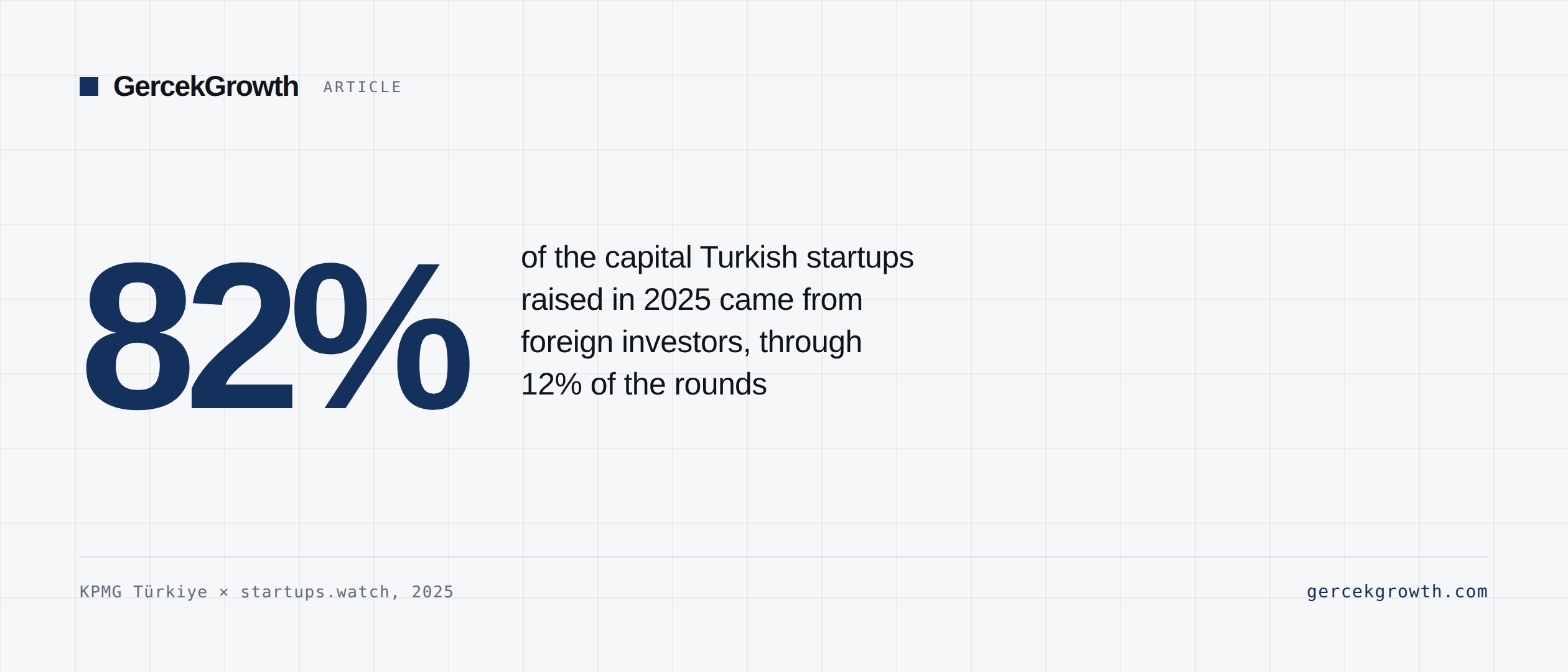
Short answer: There is no single published answer to how many Turkish startups expand abroad. The clearest hard number is this: 17% of funded Turkish startups have their registered headquarters outside Türkiye (StartupCentrum × Yıldız Tekno GSYO, H1 2024). The capital picture is sharper still. In 2025, foreign investors joined only 42 of 360 rounds but supplied $1.145 billion of the $1.4 billion total, so 12% of the rounds carried 82% of the money. In Türkiye, going abroad is not a growth preference. It behaves like a precondition for reaching capital that scales you.
Why no single rate is published
Three sources measure the Turkish ecosystem regularly: startups.watch (through the quarterly reports it publishes with KPMG), StartupCentrum and Startup Genome. All three measure investment. None of them measures how many startups went abroad. Invest in Türkiye's 2025 ecosystem report discusses the subject at length and gives no rate.
The reason is definitional. Going abroad can mean three separate things: incorporating there, landing the first foreign customer, or earning most of your revenue outside Türkiye. They happen in different years, and a startup can do the first and never do the third. A single percentage would treat all three as the same event.
So instead of one number, below are three measurements, each with what it covers written next to it.
Measurement 1. Structure: 17%
In the H1 2024 report StartupCentrum published with Yıldız Tekno GSYO, 17% of the 245 startups funded in that period had their registered headquarters abroad. The same period recorded 254 rounds and $586.8 million.
The limit matters. The rate is calculated over *funded* startups, not the whole ecosystem, and funded startups are already the subset most likely to be international, because institutional capital itself pulls the structure outward. For the ecosystem as a whole the figure should be expected to be lower.
Measurement 2. Revenue: $5.5 billion
According to the Ministry of Trade's Kolay İhracat platform, Türkiye's software and IT services exports were $3.87 billion in 2023, $5.33 billion in 2024 and $5.5 billion in 2025. In 2012 the figure was roughly $432 million, so it has grown more than tenfold in thirteen years.
TÜBİSAD's 2025 report points the same way: of the sector's 196 billion TL in exports, 178 billion TL comes from software. The sector reached $53.8 billion in 2025, up from $37.6 billion in 2024, employing 289,000 people.
The limit again matters. This money belongs to the sector, not to startups. It includes large software houses, IT services exporters and outsourcing. The startup share inside it is not published separately. But the curve is unambiguous and it points one way.
Measurement 3. Capital: 82% of it is foreign
This is the most telling figure. In the 2025 report KPMG publishes with startups.watch data, Türkiye recorded $1.4 billion across 360 rounds. In 2024 it was $2.6 billion across 331 rounds, so deal count rose while volume fell.
The split: domestic investors joined 318 rounds and contributed $227 million. Foreign investors joined 42 rounds and contributed $1.145 billion. Twelve per cent of the rounds carried 82% of the capital.
What that means in practice: you can close a seed round in Türkiye with domestic money, but the money that scales you comes from foreign investors. Getting in front of those investors generally requires a structure abroad, customers abroad, and the story told in that market's own idiom. Capital need is the first thing that pushes a Turkish startup outward.
Three things the numbers do not say
- 17% means registered headquarters, not operations. Most of these companies run a holding company abroad over an operating company in Türkiye. The team, the product and often the customers are still here. Moving the structure is not entering the market, and confusing the two is how founders end up believing they have expanded while selling nothing.
- Volume fell while deal count rose. 2025 brought more rounds, each smaller. Startup Genome's GSER 2025 puts Istanbul's median seed round at $487,000 and median Series A at $2 million. At those sizes, a US market entry is a few months of runway, not a campaign.
- The first half of 2025 was weak. 91 rounds and $211 million, with foreign investors joining only 17 of them. The full-year figure of $1.4 billion comes from a handful of large second-half transactions. The environment an average startup actually experienced is tighter than the annual total suggests.
Why they incorporate abroad
This part is legal practice, not data. Law firms working in this area in Türkiye assert that US investors generally prefer, and frequently require, that portfolio companies be US-incorporated. The same sources state that a Delaware structure lowers perceived risk with American buyers and that US intellectual property protection is stronger.
These are reasons asserted by law firms, not measured outcomes. Tax and legal consequences vary with the company's structure, and the decision requires proper legal and financial advice. This article is not advice.
Three things to measure before you go
The picture above says this: the decision to go abroad is usually triggered by capital, but raising that capital requires real traction there first. The gap between those two closes with three numbers you can measure yourself.
- How many leads the target market actually requires. Work backwards from the revenue goal: closed deals, opportunities, meetings, leads. Budget conversations before you have seen that number are guesswork. There is a tool for this.
- Whether your sending setup is ready. Cold email to the US from a brand-new domain means arriving at the spam filter with no sending history at all. Without SPF, DKIM and DMARC in place, the first campaign burns the domain. Check your domain.
- Whether you know what normal looks like. Is a 1% positive reply rate in the US a crisis or the expected number? Without an answer you will kill a working campaign early and feed a failing one for months.
Market entries made without measuring those three usually get written off as "the product didn't land". Most of the time it is not the product that failed, it is the system on top of it. The Outbound Audit takes exactly that apart.
Sources
- StartupCentrum × Yıldız Tekno GSYO, Türkiye Startup Ekosistemi Yatırım Raporu 2024 1. YarıyılStartupCentrum, 2024
- Türkiye Startup Yatırımları 2025KPMG Türkiye, startups.watch verisiyle, Mart 2026
- Yazılım ve Bilişim Sektör AnaliziT.C. Ticaret Bakanlığı, Kolay İhracat Platformu
- TÜBİSAD Bilgi ve İletişim Teknolojileri Sektörü 2025 RaporuTÜBİSAD, basın yansıması, 2026
- Istanbul Rising: How Türkiye Became a Global Leader Among Emerging EcosystemsStartup Genome, Global Startup Ecosystem Report 2025
- 2025 Yılının İlk Yarısında Türkiye Startup Ekosisteminden Öne Çıkan GelişmelerFinTech İstanbul, Temmuz 2025
- The State of Turkish Startup Ecosystem 2025Invest in Türkiye, 2025
- Delaware Flip: Türk Girişimlerin ABD YolculuğuOguz Law
Every figure above is linked to its primary source and dated. Where a number is asserted by a source rather than measured, the text says so. If you find something out of date, tell me and I will correct it.